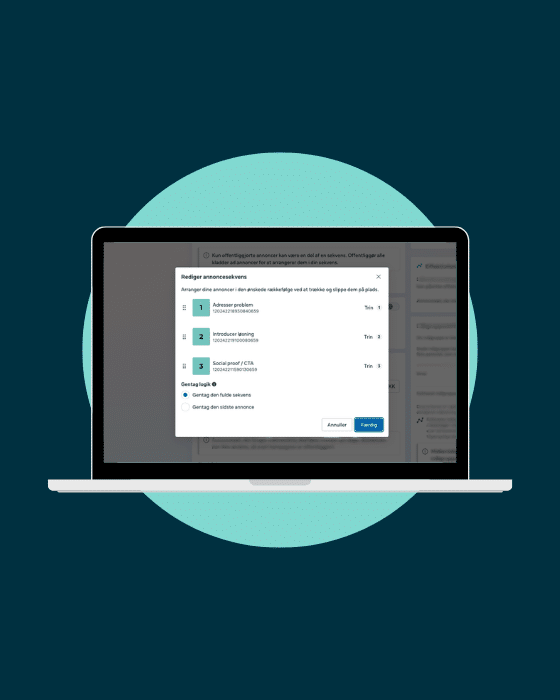
Why your Meta data lies: Understand"The Breakdown Effect"before turning off your best creatives
Do you also think you should turn off the ads with the highest cost per conversion? It seems logical, but in reality, you risk hindering your own scaling. Master the phenomenon of The Breakdown Effect and learn why your Meta data lies to you, so you can stop turning off your best creatives prematurely.
Consider this classic scenario: You have two different ads running in the same Meta campaign. The first ad acquires customers at 150 per piece. The second costs 300 per conversion.
The immediate logic, and the decision most people would instinctively make on the spot, is clear: Turn off the expensive ad and transfer the entire budget to the winning creative.
But if you do that, you actually risk slowing down your overall sales volume and driving your real acquisition costs up. It sounds like a paradox, but it is due to a well-documented phenomenon called The Breakdown Effect.
At Iternum Digital, we all too often see companies hinder their own scaling because they navigate by isolated numbers on individual creatives instead of the auction logic that Meta’s algorithm is actually driven by.
Let’s dive into what really happens to your content when you turn up the budget – and how to iterate your way around the trap.
What isThe Breakdown Effectat the Ad Level?
In short, it is a phenomenon that occurs because Meta’s core algorithm tries to give you the lowest possible average cost per result for your entire campaign, not per individual creative.
When you look at your ads, it looks as if Meta stubbornly spends most of the money on the expensive creative. It looks like an error, but it is pure mathematics based on two principles:
Law of decreasing marginal cost: The first conversions on a new creative are always the cheapest because the algorithm grabs the most conversion-ready users first. If Meta forced your entire budget into your 150 “winning ad,” its CPA would explode within a few days because it quickly runs out of the easiest customers within that specific creative’s appeal.
Discount pacing: The algorithm’s job is to make your total budget last all day. When the cheap conversions on the first ad are exhausted, it looks at your 300 ad. Had Meta forced the budget over to the winning ad, the price for the next conversions there might have doubled.
The “expensive” ad may look weak on the surface, but it has actually kept your overall campaign CPA down by absorbing and converting the market where your primary winning creative became too expensive to scale.
The best trick for scaling:Iteration of existing content
What do you do when you want to push more budget through without destroying efficiency? The answer lies in accepting that one creative cannot carry your entire scaling efforts. You must protect your bottom line by iterating your existing winning ads rather than starting from scratch every time.
If an ad performs well, formulate hypotheses as to why it works, and then make post-production edits to hit new pockets of the market:
Test new hooks on the winning video: Create 3 alternative hooks (the first 3 seconds). This fundamentally changes who the ad catches in the feed and allows Meta to find new, cheap conversions with the same content.
Segment versioning via overlays: Adapt the text or graphics (text overlays) on your winning image so that the same visual message speaks directly to different segments (e.g., one visual setup, but with different angles for different situations/target audiences).
Format iteration: Did the static image perform beyond expectations? Turn it into a simple, dynamic animation or graphic that supports the exact same message.
Handling Meta'slearning phase
When implementing these changes and iterations, you need to know the newer rules of play for Meta’s learning phase. Today, it has become significantly more stable and less sensitive to creative adjustments than it was just a few years ago.
This means two things for your content execution:
Bulk your creative updates: Do not throw one new ad version in per day. Gather your ad iterations and adjustments, and publish them in a single “bulk” update once a week. This ensures the algorithm works undisturbed and does not constantly restart its optimization.
Use significant content changes strategically: Because the learning phase is stable, it takes something radical to shake things up when your performance stagnates (“creative fatigue”). Here, fixing a minor text copy does not help. You need to make a significant change (for example, by introducing a completely new concept creative or a fundamentally different message) to reset the learning phase. This forces Meta into completely new and untapped audience pockets.
The bottom line for yourcontent strategy
Modern marketing is not about looking for the “perfect” ad and turning off the rest. It is about building a portfolio of iterated winning creatives that complement each other and allow Meta’s discount pacing to function optimally. Stop micro-optimizing at the ad level based on superficial data, and always test your new hooks in isolated testing environments before they are thrown into the big scaling engine.
Are you in doubt about whether your currentcreative setupactually supports scaling, or if you arewasting budgetby turning off the wrong ads?
Let’s have a non-binding, data-driven talk about your performance and content structure.