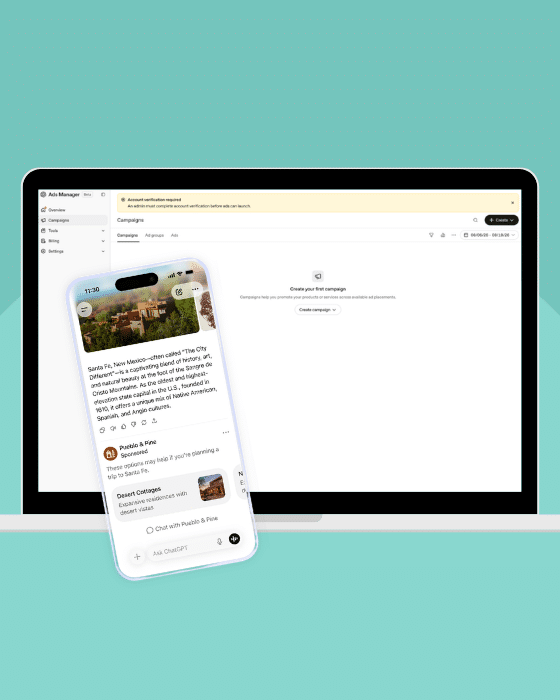
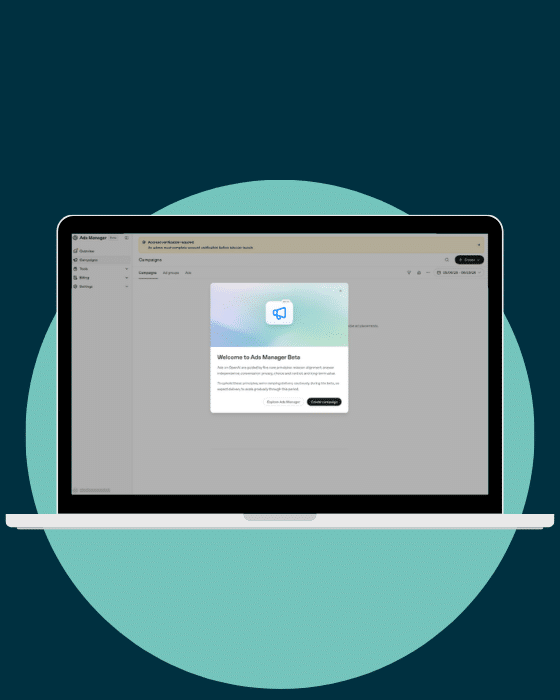
OpenAI now lets businesses claim their profile in ChatGPT and see mentions, clicks and topics. It is the first time you get first-party data from ChatGPT. Here is what the data is good for, where it stops, and what you should do now.
For more than a year, one channel has been a blind spot in most marketing reports: ChatGPT.
We could see Google traffic falling on informational searches. We could see the odd referral from chatgpt.com in GA4. But how often ChatGPT mentions your brand, and in what context, has been guesswork based on manual spot checks and third-party tools estimating from the outside.
That is changing. On 10 November 2026, OpenAI launched Businesses in ChatGPT in beta. With the new Business Hub, businesses can claim their profile, keep their information up to date, and see how often they are mentioned, how many people click through, and which topics the conversations are about.
For a marketing lead, this is more than a new feature. It is the first time you get first-party data from the platform where a growing share of your customers do their research before they ever land on your website.
In this post, we look at what Business Hub actually gives you, where the data stops, and how to prioritise it against the rest of your channel mix.
Business Hub is OpenAI’s new control panel for businesses that appear in ChatGPT. Think of it as a cross between Google Business Profile and Google Search Console, built for ChatGPT.
It has three parts:
1. A verified business profile:Â You claim your business, get it verified, and can update details such as your description, contact information, product data and more.
2. Insights:Â You can see the number of mentions, profile views, clicks to your website and the top “discovery topics”: the broad themes of the conversations where your website is cited.
3. Business Agents: Verified businesses can set up an agent that answers users on the business’s behalf inside ChatGPT. For now, this is only open to selected ecommerce and online service businesses in the US.
You claim your business through Business Hub in ChatGPT. Verification is done by text message or a call to your main business number, or with a DNS record on your domain. Shopify stores can connect directly from Business Hub or the Shopify admin, and existing OpenAI Enterprise customers and advertisers can go through their OpenAI contact.
The feature is in beta, and verification takes time. Expect a delay between claiming your profile and seeing data.
In Business Hub | Not included | |
|---|---|---|
Visibility | Number of mentions in ChatGPT’s answers | The actual prompts users wrote |
Traffic | Clicks to your website, profile views | What happens after the click (you measure that yourself) |
Context | Discovery topics (broad themes) | User data and conversation content |
Competition | Benchmarks against competitors |
Two caveats matter. Insights are aggregated and only appear once there are enough conversations to meet OpenAI’s privacy thresholds, so smaller brands may see empty or thin dashboards at first. And according to OpenAI, advertising in ChatGPT does not change how often ChatGPT recommends a business organically.
“Now we can see what people are searching for.”
No. You get themes, not prompts. Discovery topics tell you the contexts in which you are cited, but not the exact wording or who asked. It is directional data, not keyword data.
“Lots of mentions means we are doing well.”
Not necessarily. A mention says nothing about how you are described, or whether you are recommended over a competitor. And with no benchmark, you cannot tell whether 5,000 mentions is a lot or a little in your category.
“The click-through rate is low, so the channel doesn’t work.”
Expect low click-through rates. In early data OpenAI shared with selected publishers, click-through rates were around 1-2 per cent. Users often get their answer directly in ChatGPT. The value lies in being part of the decision, even when nobody clicks.
“If we advertise in ChatGPT, we will also be recommended more organically.”
OpenAI says paid placements are kept separate from organic answers and do not affect how often a business is recommended. Organic visibility and advertising should be planned together, but they are two different levers.
Business Hub does not solve your attribution problem. But it gives you something you did not have before: a baseline.
Until now, GEO (Generative Engine Optimisation) has been hard to prioritise because its impact was hard to prove. You could invest in content, structured data and digital PR, but not show whether it moved anything in ChatGPT. Now you can track mentions and clicks over time and set them against the work you do.
Bad decision | Consequence | Better decision |
|---|---|---|
Waiting until the feature is “finished” | Competitors shape how ChatGPT describes your category | Claim now and build a baseline from day one |
Leaving the profile untouched once claimed | Outdated prices and product data in ChatGPT’s answers | A named owner and a fixed update routine |
Using mentions as the only success KPI | Focus on volume over relevance | Map discovery topics to your key categories |
Treating GEO and ChatGPT Ads separately | Duplicated work and gaps in customer insight | Shared insights across organic and paid |
1. Claim your business:Â Do it now, even if the data comes later. Agree internally who owns the profile and which verification method you will use (phone, text or DNS). DNS usually needs IT or your web agency involved.
2. Clean up your data before ChatGPT does it for you: Review your business description, contact details, prices and product feeds. It is the same data that powers Google Shopping and Meta catalogues, so the clean-up pays off in several places.
3. Take a manual baseline today: Ask ChatGPT 10-20 of the questions your customers typically ask. Note whether you are mentioned, how, and who else shows up. This fills the gap Business Hub leaves: the competitive picture.
4. Set up measurement after the click: Make sure traffic from chatgpt.com can be separated in GA4 and your CRM, so you can track revenue, leads and conversion rate, not just clicks.
5. Use discovery topics as a content brief: When the first themes appear, compare them with the categories you want to win. Where topics are missing is where your next content and PR effort should go.
Business Hub does not make ChatGPT a fully measurable channel. You get no prompts, no competitive picture and no conversion data. But for the first time, you get data straight from the source on how often and in what context your business appears.
The businesses that get the most out of it will be the ones that claim early, keep their data sharp, and connect the insights to the rest of their marketing: SEO, content, product feeds and advertising.
Get a free GEO analysis, where we review your visibility, who gets mentioned instead of you, and where you can improve fastest. No strings attached. Get in touch and let’s talk.
Share on Social Media